
Stress Management as a way of life.
In these modern times of ours stress is increasingly becoming
a way of life for all kinds of people. And now, with mocks and, gasp,
even real exams creeping up on everyone. Stress management is
becoming more and more important. And not just for the pupils. Mr.
Forse is a busy man, some say too busy. His blood pressure has been
clocked at five thousand atmospheres in times of crisis, and this
explains the near gingerness of his hair (blood finds escape route
through the folicles, gruesome but allegedly true.). The school at
least acknowledges the problem: last term some crazy woman came and
talked to us about means of stress management. She gave some basic
ideas, such as simple forms of meditation and deep breathing
exercise, but I felt that this wasn't enough and that you, the
pupils, deserve more. So I went up to her after the talk, and asked
her for some more advanced ideas. And d'you know what? She just
happened to have some ideas to hand. So here they are.
1.Playing dead.
This technique is similar to the deep breathing exercise that
we were shown. However, whereas the deep breathing system states that
you should take a deep inhalation and then slowly exhale, the so
called 'playing dead' technique is quite different and can be split
into two different categories, both having the same ultimate effect.
One states that you should gradually reduce your breathing rate until
your breathing is imperceptible to the naked eye, the other states
that you should take a deep breath, as before, then hold it. Then,
you concentrate your ki / chi / pranic force / soul / prayer / karma
etc. on not dying and lowering your pulse. This stress management was
developed by yogi in India during the nineteenth century. (There is a
corresponding system developed by Boo-boo at around the same period,
but I don't have the details here.)
If you have correctly executed the technique, you will be safe for
harrassment by coursework demanding educationalists for at least a
day, and perhaps more as you pretend to recover in hospital. Highly
effective but also not without risk. However, my conscience won't
allow me to go without saying that UNDER NO CIRCUMSTANCES SHOULD YOU
ACTUALLY TRY THIS. IT IS A JOKE! Safer and easier to do is the
following.
2. Acting Crazy.
This technique is much easier and can be practiced by beginners in
dire circumstances. For a couple of days, whenever anybody talks
about whatever it is that stresses you out, go silent and look
worried. You must also look withdrawn in the lesson that bothers you.
This is laying the groundwork for the full technique, although it
will often be sufficient itself. If this doesn't work, knock the
killer blow: sit in an empty bay in the library, put a piece of paper
in front of you, and write the title of the required coursework /
subject on it, over and over again until the page is full. Then sit
and stare into the mid distance. This is the boring bit. It might
take ages for someone to notice you. But persevere, and don't move or
react, no matter what. And you will eventually be sent home. Your
parents will probably come and pick you up in fact. So, tell them,
once you have come down, that you are worried about your work,
because you're not top of the class, or, break down and tell them
that whatever teacher it is is putting you under too much pressure.
This should work a treat (it is as yet just theory) but I must warn
you that if you have any dignity, and want to keep it, this probably
isn't the technique for you. It is also only really worth trying in
extreme situations.
3. Cranial Super-Massage.
This relies on an interesting quirk of physiology, and the way that
the brain works. Endorphines are hormones that give you a rush, it is
one of the things that drugs like smack, crack or wibble try to mimic
the effects of. In short, in sufficient quantities, the endorphine
hormones produced and released by the endocrine glands directly into
the blood circulatory system act as a kind of physiological bribe, if
you will, which the brain can cause to be released in order to
stimulate a specific act or action from parts of the body which would
otherwise be unable to produce the effect desired by the brain,
without, that is, the endorphines that the brain instructs the
endocrine glands to manufacture to warrant the action is requires to
be made by the otherwise unable part of the body. Simple. A diagram
is given below that may initially confuse you but will be explained
shortly.
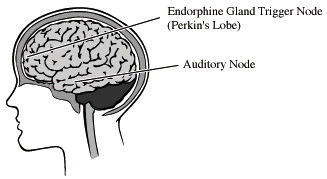
The Perkin's lobe at the front of the head stimulates the
production of the endorphines, and instructs them o be released.
Ordinarily this is controlled automatically by the subconcious
nervous system, but it can be force stimulated by receiveing a sudden
jolt or impact from the front of the cranium. (This explains the
supposed rush of boxing, and the fact that long time boxers reach a
point when they actually enjoy being hit: they are used to the pain.)
Whilst painful (and potentially damaging to the rest of the brain),
if executed correctly, it can release a sudden blast of relaxing
endorphines into the blood stream, which actually clears stress from
the system, and helps you to think. Ideally, this blow should be
delivered by yourself, to ensure perfect timing, and should be
executed by striking your forehead square-on with the palm of your
hand.
The reason for the labelling of the auditory node on the picture is
because of a lesser known attribute that people are starting to latch
onto now: the auditory nerves and the Perkin's lobe are closely
linked: hence the relaxation effects of certain typoes of music. A
sudden self-vocalisation, timed to be synchronous with the strike to
the forehead can enhance to effects of the hormones. Ideally this
vocalisation should be concise and short: this means that after the
noise, the body is relaxed. Researchers in UCLA have found that 'Doi'
or preferably 'Doh' is the perfect vocalisation.
This technique is simple and easy to acheive, and can also be used
on others: the next time a member of staff starts having a stress at
you, crack them sharply on their forehead. They will thank you
greatly for it. Also, it would be nice if we all helped out Mr. Forse
once in a while. So next time you see him running around like a blue
arsed fly, maybe you'd like to smack him around the face a few times.
I know I would.
4. Buy
the all new StressMaster5000®.
Your stress will just melt away. Try it.
5. Seriously though.
I feel I have to say this because stress can really grind some people
into the dirt, with golf shoes on. If the above techniques fail to
work (hmm, seems unlikely.) and you really think its piling up and
getting too much, don't panic. If you try and do something in a
hurry, it usually takes longer, and it usually goes wrong, which
frustrates you even more, and adds to the problem. Talk to your
teachers, let them know how you feel. Talk to your parents, don't be
a martyr. If you screw up your health now, if will really mess you up
in the years to come. So try and do the work, and do it as soon as
you can once you get it. Exams; same idea really, do the revision,
but don't kill yourself. Just get organised. And don't spend all of
your time revising. Go and doss around, watch TV, play on the
computer, read this, stick pins in a wax effigy of ForseMan, etc.
Whatever happens, you should be in charge of your own stress, not the
other way round. Sorry to sound all moral, but lets face it, it can
be pretty bad. I've been there, and a bit of proportion would have
done me the world of good at the time. Thank you for listening.
